Understanding Reinforcement: A Key to Building Skills in Children
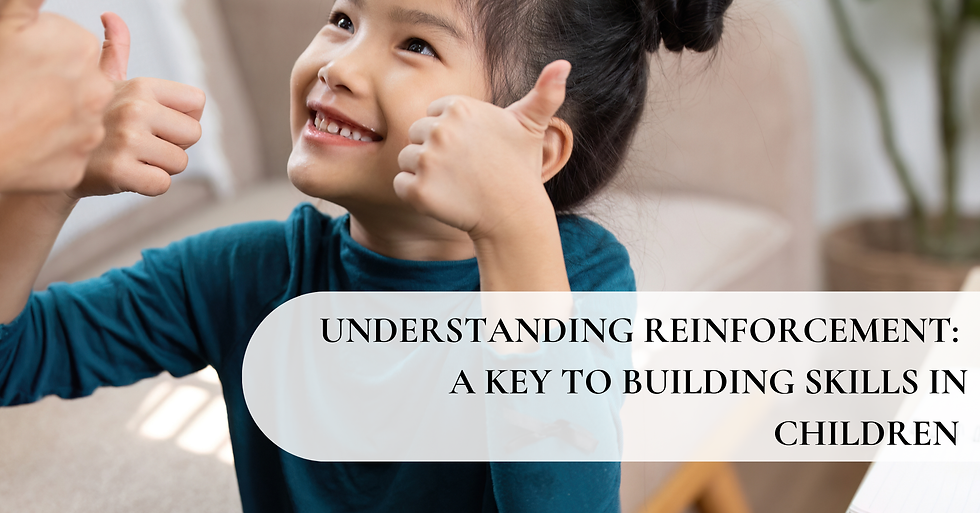
Reinforcement is often one of the first "new" words that parents encounter when they begin learning about ABA (Applied Behavior Analysis). It sounds technical at first, but once we understand it, it can become a practical cool that we can use in everyday life with our child.
So what is reinforcement, really?
Looking at it in simple term, reinforcement is anything that increases the possibility of a behaviour happening again. So if a behaviour happens, and something that comes after the behaviour makes our child want to do it again, that is reinforcement.
For example:
Our child says "water" --> we give them water --> they are more likely to say "water" again next time when they want or need water
Our child cleans up toys --> they are praised or given positive attention --> they are more likely to clean up again or the next time.
So here, we understand that reinforcement helps children learn, grow, and build meaningful skills step by step.
Our children are constantly learning from their natural environment. Every reaction they get whether it be from adults, siblings, teachers, the reaction shapes their behaviours.
When reinforcement is used intentionally, we can encourage communication, build independence, strengthen social skills, and also reducing challenging behaviours by teaching better alternatives. Reinforcement helps us to teach our children what to do instead of only focusing on stopping behaviours.
So what does reinforcement looks like, or what counts as reinforcement?
Now it looks different for every child because what motivates one child may not work for another. Same goes when we look at it in adult's context, what motivates me may not motivates you. Each children will have different preference and that's alright.
Some common types of positive reinforcement include:

Reinforcement doesn't have to wait for therapy sessions because it is already happening in our daily routines. Here are a few simple examples on how we can practice positive reinforcement:
When our child tries to communicate to us, we respond quickly and positively
When our child follow instructions, we acknowledge their effort
When they show a new skill, celebrate it even when the skill is "small".
So a gentle reminder to us parents, when reinforcement is given, it shouldn't be taken as "rewarding everything" or "spoiling" our child. The culture of rewarding differs; culturally, parenting style, and how we were brought up. But we need to understand that reinforcement is about noticing our children's effort, encouraging their growth, and also helping our children to understand what works.
Learning is a process, and every child moves at their pwn pace. Reinforcement simply helps guide them along the way; with support, consistency, and encouragement.
All the best!
With care and intention,
Mary Jane
STEP Behavior & Family Consulting
Disclaimer:
This post focuses on introducing the concept of reinforcement in a simple and practical way for everyday use. It does not cover the full framework of behaviour principles in ABA, including the four key processes: positive reinforcement, negative reinforcement, positive punishment, and negative punishment.


Comments